Tuesday, 26 April 2016

How to Stretch or Straighten Natural Hair SAFELY


Hey HoneyVerans!!!
Here's the truth, sometimes naturals want their hair to be more manageable and showoff their length let's do safely... 

Step 1: Heat Protection

Always, always, ALWAYS protect your hair when it comes to manipulating it with heat. Protecting your hair from dryness, cracked cuticles, breakage, and heat damage starts on wash day. A moisturizing shampoo or cowash, a great deep conditioner, and stellar heat protecting/leave-in products are a must. Making sure hair is properly moisturized and protected will guarantee a better finished product. These products are all great heat protectants that will help moisturize, strengthen, and prevent heat damage:

Step 2: Check The Method

Once you've got your product arsenal together, it's time to discuss methods for heat stretching. There are 4 popular methods for heat stretching to choose from (okay so one of them is a little unconventional, and I totally stumbled upon it on accident one day).
TENSION METHOD
The tension method is one of the least damaging ways to go from dripping wet to dry hair. All you need is a blow dryer with a concentrator nozzle. With hair parted into however many sections works for you (I do 5-6), apply your protection products of choice. With your hair detangled and smoothed between your fingers, gently stretch it downward. With hair in the stretched state, gently move the concentrator nozzle down the shaft of the hair repeatedly until dry. The downward motion provides a better stretch. Medium or low heat with high speeds are recommended with this method.
BLOWDRY WITH COMB/ATTACHMENT
This is your regular, run-of-the-mill blow drying session. It has the propensity to cause the most damage, but it is also the most effective if you are looking to get super straight stretched hair. This method involves applying protection product, and either with a wide-tooth comb or comb attachment, moving through the hair with the blow dryer at medium or low heat and high speed. You can use the high setting if you choose, for a straighter look. However, the hotter the blow dryer, the faster it zaps moisture from your hair.
BAND/BRAID THEN BLOW DRY
Because blow drying can literally zap the moisture out of the hair, some naturals and transitioners prefer to let their hair air dry partially first. The most effective way to air dry is with the hair completely loose, but this lends itself to massive shrinkage, tangling, and breakage. To ward off those natural hair horrors, banding the hair or putting the hair in loose braids works well. Once hair is about 75% dry, you can then use either the tension or comb/attachment blow drying method to finish the job.
STEAMER BLOWOUT
This one I stumbled upon on accident. Way back when I got my Q-Redew, I began using it to refresh, moisturize, and detangle my hair. One random evening, I decided to ditch the conditioner to detangle, and see what 100% steam-only would do to my hair. The end result: a massive blowout that was super moisturized! This is surely the way to go if you are terrified of the blow dryer. There is gentle heat, but the water infuses moisture deep into the strand which prevents drying. Will it give you better results than a blow dryer? Maybe. Will your hair be dry afterward? Absolutely not! Check out my Instagram to peep the blowout picture!
FLAT IRONING
*cue horror music* This is the one straightening/stretching method that sends chills throughout the natural hair and transitioning community. After doing so much hard work to get curls healthy, everything could be for naught in one fell swoop. But if you do it right, the results are gorgeous and your curls will revert 100%. You need clean hair (shampoo clean, not cowash clean) that has been deep condition, and dried via one of the above methods (except steaming). Heat protection here is SUPER important! I recommend a heat protectant before blow drying, and a serum before flat ironing. Garnier Fructis Sleek & Shine Moroccan Sleek Oil Treatment is my favorite flat ironing serum to use. Using a flat iron with a visible temperature gauge (no high, medium, low!), make 1 or 2 passes (no more than 2) over super small sections of hair. It is CRITICAL that hair be 100% dry before flat ironing to prevent bubbling within the shaft. Also, while temperature tolerance varies head-to-head, it is generally a good idea to keep flat iron temperatures below 400 degrees Fahrenheit. Ideally, under 380 degrees. Click here for more in-depth information about flat ironing hair.

Step 3: Moisturize and Maintain

Maintaining moisture levels in heat stretched hair can be difficult. Water-based anything will cause immediate reversion. But at the same time, water is the one true moisturizer. Talk about a paradox! One of the best ways to combat this is to regularly moisturize the hair with an oil that is known to penetrate the hair shaft. Easiest, most accessible, and affordable is coconut oil. Applying it sparingly throughout your stretched hair stint will help keep the hair moisturized, and protect the ends which are incredibly prone to drying out. Other oils that penetrate the hair shaft (although not as effectively as coconut oil) are: grapeseed oil, argan oil, palm kernel oil, and flaxseed oil. Ucuuba butter is also known to penetrate the hair. At this stage, it is super important to avoid silicone-based serums. They don't penetrate the hair, and they can have a mild occlusive effect and prevent other moisturizers from getting in as well. Although it may be more expensive, 100% pure oil is best. Cold pressed, virgin, and unrefined is even better. 
pic source, article source

Email: honeyveraja@gmail.com
Whatsapp: 876-454-7789

CLICK & FIND US:


Monday, 25 April 2016

Increase Hair Moisture: Water Your Hair Like a Plant


hydrating natural hair
Hey HoneyVerans!
Your hair LOVES MOISTURE! Like a plant needs water, so does your hair. To grow beautifully, especially if moisturized with the right product. Here are a few pointers: 

  1. Stop using sulfates

This is a no-brainer. Sulfates are harsh detergents in many shampoos (and laundry soap) that strip the hair of sebum, the natural oil our scalp produces to moisturize itself. If you want to retain moisture, you need to avoid sulfate shampoos.
  1. Start co-washing

Sometimes, even sulfate-free can be too drying for curly hair. Using conditioner to wash the scalp is an alternative to shampoo. You can use any daily conditioner or you can buy specially formulated co-washes. Co-washing moisturizes dry hair and prevents it from becoming stripped of its natural oils.
  1. Deep condition regularly

I am sure that many of you already deep condition, but here’s the thing, it’s time to buy a real deep conditioner. A lot of curlies like to save money by making DIY masks or using regular conditioner to deep condition, but no mixture will do what a specially formulated deep conditioner can do. Splurge on a good deep conditioner, your hair needs it! And although deep conditioning is recommended once or twice a week, it’s okay to deep condition your hair every time you shower. For a deeper condition, put on a shower cap to trap the heat in. (Our VeraGrow Scalp Tonic Spray is an easy and great way to moisturize and deep condition daily).

  1. Seal with oil

Curly hair tends to be dry because the hair cuticle is naturally raised thus leading to moisture loss. Help your dry hair retain moisture by oiling it immediately after showering. The oil seals in all the water and conditioner from your wash and go and create a barrier to prevent moisture loss and promote shine. Any oil is fine, coconut oil is very popular for its strengthening properties. (...and blended with castor oil you get even more benefits from our Castor-Coconut Hair Oil)

  1. Condition everyday

You have heard people say to not shampoo every day, but no one ever said you can’t condition every day. If your hair becomes parched by the end of the day then it won’t hurt for you to give your hair the thirst-quenching moisture that it needs. You can just jump into the shower and condition your hair every morning. Conditioning every day will also lead to hair with less tangles! (Use VeraGrow Scalp Tonic Spray to CONDITION DAILY)
  1. Sleep with satin

Protect your hair overnight to retain moisture. Sleep on a satin pillow case or sleep with a satin bonnet. Cotton is very absorbent and can steal the moisture from your hair while you sleep. Satin is a sleek material that won’t cause frizz and will help with moisture retention.
pic source, article source

Email: honeyveraja@gmail.com
Whatsapp: 876-454-7789

CLICK & FIND US:


Wednesday, 20 April 2016

5 Reasons You SHOULD NOT Comb Your Natural Hair Everyday

Artwork by: Jeffrey Perry 
Tel: 876-859-3499

Hey HoneyVerans!!!

5 Reasons Your Natural Hair isn't designed for regular combing

Many of us can attest to our hair breaking one or two or more combs as we tried to force a comb through our knotted and dry kinky hair! Many of us probably grew up in cultures where our hair has to be combed daily, before we were allowed to step aside. Let's admit it, a Teeny Weeny Afro (TWA) does look funny when it's coiled up and not combed. While one can get away with combing afro hair that's less than 3 inches daily, without much damage, any hair that's longer than this length will require that you use your comb less often.

 I often have women tell me they'll rather relax their hair because it's easier to comb, and those with natural hair choose to wear wigs and hair extentions because they don't have to deal with combing their hair often. Not only is this statement very sad to hear and doesn't make sense, it's also very appalling! Curly hair isn't designed for a comb, neither are combs designed for curly hair (at least in my opinion).

I've listed below, 5 reasons why your Afro hair shouldn't be combed often 


1.  Since our hair isn't straight, it doesn't need to be combed everyday in order to main its aesthetics. Curly and coily hair is happy being coiled up and so it has the tendency to coil back up and sometimes intertwine with each other right after combing. 

Natural Hair Types
*Source*
Say you have 4b hair, each time you comb your hair, you're taking it through 8 DIFFERENT HAIR TEXTURES, and then with time, it eventually goes in the reverse direction and returns to it's original 4B texture. So in total, your hair goes through 16 stages every time you comb it!

2. From the analogy given above, it's very clear that regular hair-combing will result in mechanical damage, which can be an impediment to healthy long hair. Since our hair has the tendency to coil up with each other, combing the hair will forcefully separate and break up coiled hair strands. This forceful separation will lead to hair breakage and split ends. So while you may think you're taking good care of your hair by combing it, you're actually doing the opposite by killing it.

3. Since every curly hair has the tendency to curl back up, combing it would be a waste of time. Unless you intend to wear your hair in a particular style which requires your hair to be perfectly combed out, combing it would be unnecessary.

4. Combing Afro hair can be painful, particularly if combed dry, which most people tend to do! Even if the hair is combed the proper way, which is hair wet and saturated with a slippery conditioner and oil, and then combed from the tips/ends to the roots; combing our hair can still be uncomfortable. I have a sensitive scalp, so any tugging and pulling can be very painful.

5. Combing Afro hair takes time! As you may know by now, your hair can't be combed the same way you would comb a weave or any other straight hair. Based on a previous post I wrote on my blog on Natural hair combing, I listed 5 steps that must be followed to effectively comb Afro hair. So unless your hair absolutely must be combed for a particular style, you can skip this step and move on to styling.

In conclusion, Afro hair likes to be KINKY!  Our hair is happy and relaxed, when it's coiled up. So temporarily disrupting the coil pattern in our hair will result in unhappy and tensed tresses.
Remember, our hair is unique and must be treated as such. The exotic texture of our hair requires foreign and sometimes uncommon hair practices which might not make sense! 

article source, pic source


Email: honeyveraja@gmail.com
Whatsapp: 876-454-7789

CLICK & FIND US:


Sunday, 3 April 2016

Overdrive - Life after "30": Honey Vera PRODUCT REVIEW


Hey HoneyVerans!!!!!!

We stand by the fact that our products work. But we love even more when you acknowledge that our products do what we say. Here's a product review from:

Overdrive - Life after "30"


Honey Vera JA Product Line


"BAD hair day, ain't nobody got time for that."

Imagine an article from the Beyond Beauty series written by stylist and blogger Natalia Oh published in Jamaica Gleaner had me in awwwww with this young lady.  Yes, I read her story and I was literally in tears!!!! I immediately shared the story with a few of my closest friends. Following her published story in Jamaica Gleaner, I saw her again showcasing her talent on SMILE Jamaica.  What caught my attention was her flawless skin and her beautiful hair.  After seeing another article of hers about her product line, I knew then that I had to give it a try on my daughter's hair.

I had gotten in touch with Christal Ann and asked my friend to purchase 6 sets.  YES, I had confidence in her product and wasn't sure if I would return to Jamaica anytime soon.  After trying the product the first week on my damaged perm hair at the time, I was HOOKED.


Soon after, I was using the castor oil  and tonic or my daughter's hair and noticed a HUGE difference.  Arielle's hair wasn't shedding and was thicker and healthier.  The scalp issue was pretty much gone after a month of using the hair tonic consistently.  For the past year, during my transition, I have used the hair tonic consistently on my scalp while my hair was still in braids.  I have minimal shedding when I removed my braids and I was surprised by the growth.  Last summer, I decided to do the BIG chop and wasn't confident or bold to wear my fro.  6 months later after braids, I am in awww by the growth and thickness.


How I use the Honey Vera products?


     I am a big fan of trial and error.  I actually received a set of the entire line last summer and currently only uses it  when my braids are out.  I wash with the shampoo, then deep condition with the oil for the entire day and  spray the tonic on my hair.  As for my daughter's hair, we have to use the tonic every other day as it helps with her severe scalp issue.  In addition we use the oil 2-3 times a week and braid overnight to lock in the shine.

     When styling my hair, I spray the hair with the tonic and use the gel throughout the hair then add the oil after.  It seems to work better that way as the tight curls stay moisturized throughout the day.

WE are truly in love with Honey Vera!!!!.  She spends hours perfecting her craft and product line, traveling to different events and most importantly listening to feedback and suggestions.


Christal Ann is one phenomenal woman who is truly an artist at heart.  Not only does she cooks, paints among other talents, she is a LADY of high esteem and character.  I will always support her in all her endeavors as a black woman of talent and strength.

DON'T forget to go check her out on Facebook at Honey Vera JA or on Instagram.  Feel free to email her to order your products at honeyveraja@gmail.com

Thanks for reading and please feel free to share your comments below if you have tried her products.


Email: honeyveraja@gmail.com
Whatsapp: 876-454-7789

CLICK & FIND US:


Wednesday, 30 March 2016

Castor Oil and Virgin Coconut Oil: Great Benefits


Hey HoneyVerans!!!!

There are many natural formulas for keeping your hair healthy, shiny and strong. Using castor oil is an old, traditional way of taking care of the scalp and hair. Read about the benefits of castor oil, which is derived from seeds or beans of castor oil plant (Ricinus communis), and learn how to apply it to your hair.

Benefits of Castor Oil for Hair

Castor oil has been well known for its medicinal properties. It’s often used as a laxative, but has a wide variety of other health benefits, including many pertaining to hair and hair growth, as well as for facial oil cleansing method, stretch marks, dark spots and more.
The oil has a unique chemical composition, which most likely contributes to its healing potential. It mostly consists of a triglyceride of fatty acids. It contains vitamin E, omega-6 fatty acids, minerals, and proteins, which are all important for the health of your hair and scalp.
Castor oil:
  • helps with hair regrowth and hair loss,
  • makes the hair richer and darker,
  • prevents split ends,
  • treats dandruff and dry scalp,
  • moisturizes the hair and makes it shine,
  • works in an antifungal and antibacterial way and can prevent problems such as piedra, ringworm, and folliculitis.

How to apply castor oil

It’s best to use castor oil as a hair mask. This is particularly helpful if you’re trying to regrow hair or give it more moist and shine.
  1. Castor oil has a thick consistency, so you can mix it with coconut oil, olive oil or jojoba oil in a half and half ratio. This will make the mask easier to distribute throughout your hair.
  2. Use your fingers or a brush and start applying it onto your scalp with circular motions. This gentle massage increases the blood circulation, rejuvenates the hair, and stimulates hair growth.
  3. Part hair into sections and apply the oil (mixture) to each section until all your hair is covered properly and evenly.
  4. Wrap your hair in a warm towel (you can also use a shower cap) and leave it for two to eight hours. You can also leave it over night. This will give the oil enough time to penetrate the follicles and hydrate your scalp and hair thoroughly.
  5. Wash your hair as usual using shampoo and conditioner. Make sure you rinse all the oil out of your hair.

How Often Should you Use Castor Oil?

This depends on your objective and type of hair.
If your aim is to treat hair loss, you will need to do it at least twice weekly, but even better if you can do it three or four times per week for several weeks. You can also add rosemary essential oil which is known to stimulate hair growth , and also work out to find the cause of the hair loss.
For split ends and increased shine, you can use the oil as a conditioner once weekly. Be careful not to use too much of it (a pea-sized amount should do) or you can end up with an over-oily scalp.
For best results use unrefined castor oil, as it contains more nutrients and healing properties.

6 Reasons to Treat Your Hair with Coconut Oil

Coconut oil stimulates hair growth getting deep into its follicles.
Coconut oil promotes the scalp health fighting against such problems as insect bites, lice and dandruff.
Coconut oil moisturizes dry hair.
Coconut oil adds luster, shine and softness to the hair.
Coconut oil prevents hair breakage and split ends, contributing to hair length.
Coconut oil slows down hair loss.


How to Use It for Your Maximum Results

Coconut oil is to be applied over the scalp and hair. Then you should comb it through the hair, so that to reach every strand. Furthermore, it is strongly advisable to warm the oil before applying, massage it into the scalp, leave it overnight and wash in the morning with shampoo.

Coconut Oil for Hair Growth: Your Gorgeous Glossy Head + Extra Natural Protection

As far as hair is like a tube, hollow from inside, coconut oil completely penetrates this space. As a result, the hair shafts are filled up and given more body. Your hair looks denser and fuller.

Fatigue Prevention

Hair gets damaged by swelling and shrinking of fibers, because of water retention and absorption. Such a ‘hygral fatigue’ is prevented by coconut oil, which protects the hair from possible damage.

Reduces Protein Loss

Do you know that our hair is total protein composition? Thus, protein loss from hair ends up in weak and unhealthy hair. Coconut oil treatment significantly reduces this protein loss from either damaged or undamaged hair. Researchers have discovered that it is the only oil to provide such a reduction.

Conditions from Within

Coconut oil retains moisture, so necessary for well-moisturized and strong hair. This keeps the hair shiny and silky. Coconut oil also conditions the hair from within, protecting it from heat and environment damage.

Anti-bacterial Properties

In addition, coconut oil has antibacterial properties and nutrients, responsible for ideal hair and scalp protection from bacteria/protozoan/viral infections.

More so, women using coconut oil can stop getting gray and keep their dark hair even when old!

Magical Coconut Oil

Well, are you ready to promote luxurious hair growth with magical coconut oil? Join all those people throughout the world, who have already acknowledged its beneficial effects! You’re going to possess your own long and luxurious hair, no matter whether it is male and female. Here it is, your potential ticket to thick and beautiful locks!
article source


Here we've made a two-in-one for you :) 

Email: honeyveraja@gmail.com
Whatsapp: 876-454-7789

CLICK & FIND US:


Monday, 28 March 2016

Eat these for LONGER HAIR


Hey HoneyVerans!!!!!

You are what you eat--literally.

And because your hair is part of you, what you eat reflects in the health and state of your hair. If you want hair that is healthy, longer, stronger and shinier you should be paying attention to what you put INSIDE your body, not just what you use on the hair itself. These superfoods will help keep you and your hair looking their best.

1. Water + VeraGrow Scalp Tonic = Hydration 
Not a food but-- we are primarily made up of water. It is important to stay hydrated and to keep all of your body cells working properly. By drinking enough water daily, you are also helping the hydration and moisture levels of your hair as well. By not drinking enough water daily, you are hindering your hair growth as well. If you don't like the taste or want to spruce up your regular water, infuse it with some berries or citrus, which will give you added vitamins as well.
2. Omega-3 Fatty Acids, Iron, Vitamin D = Salmon 
Salmon is a healthy food superstar; it is an oily fish rich in protein, vitamin D, and fatty acids. The Omega-3 fatty acids are necessary for a healthy scalp, resulting in hair growth. Salmon also contains iron and Vitamin B12 which can help promote strength and shine in your hair. If you don't like fish, flaxseeds are a good vegetarian replacement for these nutrients.
3. Biotin, Vitamin B, Protein= Chicken & Eggs 
Which came first, the chicken or the egg? A diet with both contains good sources of protein that will really help your hair! Hair and nails are both composed of protein, which supports body and hair strength. Your hair is the last part of your body that gets the protein, so a lack of this in your diet could affect its state of hair fall and length retention. Eggs are full of B vitamins, especially biotin (B7) and panthenol (B12). Yolks have important vitamins and minerals that the egg whites do not. Chicken is a rich source of protein, as well as several B vitamins that helps to strengthen fragile hair.
4. Zinc, Vitamin C = Prunes & Oranges
Beef and oysters are rich sources of zinc, which is helpful in improving your hair's natural luster. Zinc deficiency is a cause of hair loss and dryness, so include beef and oysters in your diet. Zinc is also said to help combat premature graying of hair. Make sure to eat enough vitamin C in your diet, which will help the zinc absorption. You can find vitamin C in citrus fruits such as oranges and grapefruits, as well.  
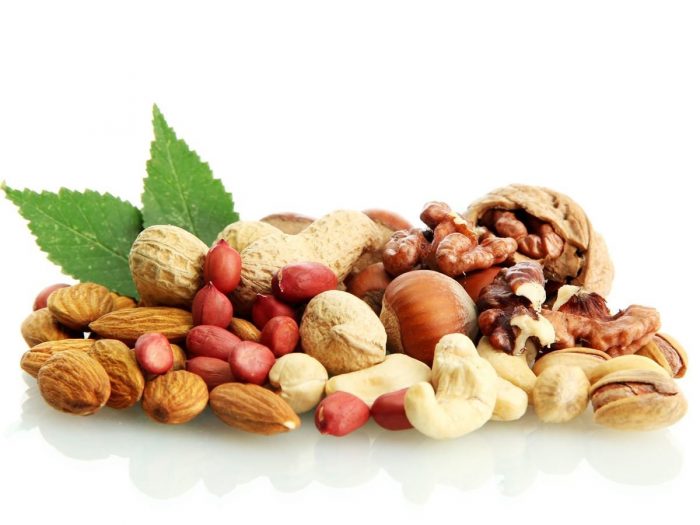
5. Biotin, Vitamin E, Zinc = Nuts 
Nuts are a great source of healthy fats, and we need healthy fats to look and feel our best. Walnuts and almonds in particular are high in omega-3 fatty acids which can help keep hair strong, and zinc which can help aid in hair loss. Walnuts in particular also contain a great amount of vitamin E and biotin. The vitamin E can help protect your cells from DNA damage cause by the environment and too little biotin can lead to hair loss. Brazil nuts are another great option to snack on for hair health. They contain a good amount of the mineral Selenium. A deficiency in Selenium has been linked to slower hair growth. 
6. Folic acid, Iron, Biotin = Lentils 
Lentils are a great vegetarian source of protein and are contain an excellent amount of folic acid. Folic acid is essential for hair growth and cell renewal and it is also necessary in restoring the health of red blood cells that supply skin and scalp with much-needed oxygen. Lentils also are a good source of iron, zinc and biotin too. 
7. Vitamin A = Carrots & Sweet Potatoes 
What do these two have in common? They're both orange. They also are an excellent sources of Vitamin A. Vitamin A helps the scalp product enough sebum. Sebum is like natural oil that your scalp products and it important for your scalp and the length of your hair to stay moisturized and not become dry and brittle. Dandruff flaky scalp is just one condition of what might happen if your scalp does not produce enough sebum.
pic source, article source (tweaked a little)


Email: honeyveraja@gmail.com
Whatsapp: 876-454-7789

CLICK & FIND US: