Wednesday, 30 March 2016

Castor Oil and Virgin Coconut Oil: Great Benefits


Hey HoneyVerans!!!!

There are many natural formulas for keeping your hair healthy, shiny and strong. Using castor oil is an old, traditional way of taking care of the scalp and hair. Read about the benefits of castor oil, which is derived from seeds or beans of castor oil plant (Ricinus communis), and learn how to apply it to your hair.

Benefits of Castor Oil for Hair

Castor oil has been well known for its medicinal properties. It’s often used as a laxative, but has a wide variety of other health benefits, including many pertaining to hair and hair growth, as well as for facial oil cleansing method, stretch marks, dark spots and more.
The oil has a unique chemical composition, which most likely contributes to its healing potential. It mostly consists of a triglyceride of fatty acids. It contains vitamin E, omega-6 fatty acids, minerals, and proteins, which are all important for the health of your hair and scalp.
Castor oil:
  • helps with hair regrowth and hair loss,
  • makes the hair richer and darker,
  • prevents split ends,
  • treats dandruff and dry scalp,
  • moisturizes the hair and makes it shine,
  • works in an antifungal and antibacterial way and can prevent problems such as piedra, ringworm, and folliculitis.

How to apply castor oil

It’s best to use castor oil as a hair mask. This is particularly helpful if you’re trying to regrow hair or give it more moist and shine.
  1. Castor oil has a thick consistency, so you can mix it with coconut oil, olive oil or jojoba oil in a half and half ratio. This will make the mask easier to distribute throughout your hair.
  2. Use your fingers or a brush and start applying it onto your scalp with circular motions. This gentle massage increases the blood circulation, rejuvenates the hair, and stimulates hair growth.
  3. Part hair into sections and apply the oil (mixture) to each section until all your hair is covered properly and evenly.
  4. Wrap your hair in a warm towel (you can also use a shower cap) and leave it for two to eight hours. You can also leave it over night. This will give the oil enough time to penetrate the follicles and hydrate your scalp and hair thoroughly.
  5. Wash your hair as usual using shampoo and conditioner. Make sure you rinse all the oil out of your hair.

How Often Should you Use Castor Oil?

This depends on your objective and type of hair.
If your aim is to treat hair loss, you will need to do it at least twice weekly, but even better if you can do it three or four times per week for several weeks. You can also add rosemary essential oil which is known to stimulate hair growth , and also work out to find the cause of the hair loss.
For split ends and increased shine, you can use the oil as a conditioner once weekly. Be careful not to use too much of it (a pea-sized amount should do) or you can end up with an over-oily scalp.
For best results use unrefined castor oil, as it contains more nutrients and healing properties.

6 Reasons to Treat Your Hair with Coconut Oil

Coconut oil stimulates hair growth getting deep into its follicles.
Coconut oil promotes the scalp health fighting against such problems as insect bites, lice and dandruff.
Coconut oil moisturizes dry hair.
Coconut oil adds luster, shine and softness to the hair.
Coconut oil prevents hair breakage and split ends, contributing to hair length.
Coconut oil slows down hair loss.


How to Use It for Your Maximum Results

Coconut oil is to be applied over the scalp and hair. Then you should comb it through the hair, so that to reach every strand. Furthermore, it is strongly advisable to warm the oil before applying, massage it into the scalp, leave it overnight and wash in the morning with shampoo.

Coconut Oil for Hair Growth: Your Gorgeous Glossy Head + Extra Natural Protection

As far as hair is like a tube, hollow from inside, coconut oil completely penetrates this space. As a result, the hair shafts are filled up and given more body. Your hair looks denser and fuller.

Fatigue Prevention

Hair gets damaged by swelling and shrinking of fibers, because of water retention and absorption. Such a ‘hygral fatigue’ is prevented by coconut oil, which protects the hair from possible damage.

Reduces Protein Loss

Do you know that our hair is total protein composition? Thus, protein loss from hair ends up in weak and unhealthy hair. Coconut oil treatment significantly reduces this protein loss from either damaged or undamaged hair. Researchers have discovered that it is the only oil to provide such a reduction.

Conditions from Within

Coconut oil retains moisture, so necessary for well-moisturized and strong hair. This keeps the hair shiny and silky. Coconut oil also conditions the hair from within, protecting it from heat and environment damage.

Anti-bacterial Properties

In addition, coconut oil has antibacterial properties and nutrients, responsible for ideal hair and scalp protection from bacteria/protozoan/viral infections.

More so, women using coconut oil can stop getting gray and keep their dark hair even when old!

Magical Coconut Oil

Well, are you ready to promote luxurious hair growth with magical coconut oil? Join all those people throughout the world, who have already acknowledged its beneficial effects! You’re going to possess your own long and luxurious hair, no matter whether it is male and female. Here it is, your potential ticket to thick and beautiful locks!
article source


Here we've made a two-in-one for you :) 

Email: honeyveraja@gmail.com
Whatsapp: 876-454-7789

CLICK & FIND US:


Monday, 28 March 2016

Eat these for LONGER HAIR


Hey HoneyVerans!!!!!

You are what you eat--literally.

And because your hair is part of you, what you eat reflects in the health and state of your hair. If you want hair that is healthy, longer, stronger and shinier you should be paying attention to what you put INSIDE your body, not just what you use on the hair itself. These superfoods will help keep you and your hair looking their best.

1. Water + VeraGrow Scalp Tonic = Hydration 
Not a food but-- we are primarily made up of water. It is important to stay hydrated and to keep all of your body cells working properly. By drinking enough water daily, you are also helping the hydration and moisture levels of your hair as well. By not drinking enough water daily, you are hindering your hair growth as well. If you don't like the taste or want to spruce up your regular water, infuse it with some berries or citrus, which will give you added vitamins as well.
2. Omega-3 Fatty Acids, Iron, Vitamin D = Salmon 
Salmon is a healthy food superstar; it is an oily fish rich in protein, vitamin D, and fatty acids. The Omega-3 fatty acids are necessary for a healthy scalp, resulting in hair growth. Salmon also contains iron and Vitamin B12 which can help promote strength and shine in your hair. If you don't like fish, flaxseeds are a good vegetarian replacement for these nutrients.
3. Biotin, Vitamin B, Protein= Chicken & Eggs 
Which came first, the chicken or the egg? A diet with both contains good sources of protein that will really help your hair! Hair and nails are both composed of protein, which supports body and hair strength. Your hair is the last part of your body that gets the protein, so a lack of this in your diet could affect its state of hair fall and length retention. Eggs are full of B vitamins, especially biotin (B7) and panthenol (B12). Yolks have important vitamins and minerals that the egg whites do not. Chicken is a rich source of protein, as well as several B vitamins that helps to strengthen fragile hair.
4. Zinc, Vitamin C = Prunes & Oranges
Beef and oysters are rich sources of zinc, which is helpful in improving your hair's natural luster. Zinc deficiency is a cause of hair loss and dryness, so include beef and oysters in your diet. Zinc is also said to help combat premature graying of hair. Make sure to eat enough vitamin C in your diet, which will help the zinc absorption. You can find vitamin C in citrus fruits such as oranges and grapefruits, as well.  
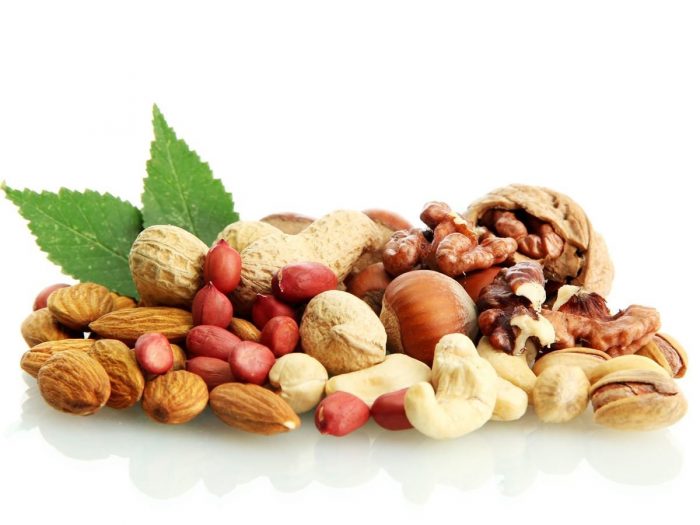
5. Biotin, Vitamin E, Zinc = Nuts 
Nuts are a great source of healthy fats, and we need healthy fats to look and feel our best. Walnuts and almonds in particular are high in omega-3 fatty acids which can help keep hair strong, and zinc which can help aid in hair loss. Walnuts in particular also contain a great amount of vitamin E and biotin. The vitamin E can help protect your cells from DNA damage cause by the environment and too little biotin can lead to hair loss. Brazil nuts are another great option to snack on for hair health. They contain a good amount of the mineral Selenium. A deficiency in Selenium has been linked to slower hair growth. 
6. Folic acid, Iron, Biotin = Lentils 
Lentils are a great vegetarian source of protein and are contain an excellent amount of folic acid. Folic acid is essential for hair growth and cell renewal and it is also necessary in restoring the health of red blood cells that supply skin and scalp with much-needed oxygen. Lentils also are a good source of iron, zinc and biotin too. 
7. Vitamin A = Carrots & Sweet Potatoes 
What do these two have in common? They're both orange. They also are an excellent sources of Vitamin A. Vitamin A helps the scalp product enough sebum. Sebum is like natural oil that your scalp products and it important for your scalp and the length of your hair to stay moisturized and not become dry and brittle. Dandruff flaky scalp is just one condition of what might happen if your scalp does not produce enough sebum.
pic source, article source (tweaked a little)


Email: honeyveraja@gmail.com
Whatsapp: 876-454-7789

CLICK & FIND US:

Thursday, 24 March 2016

Define Your Twist Out


HEY HONEYVERANS!!

The steps to a twist out are pretty simple, but you're not looking for any old twist out. If you want your most definition ever while maintaining plenty of lift and volume at the roots, there are a few steps that you simply cannot skip. You won't need many products (in fact, if you choose a multi-use product you only need one) and the technique is simple to follow. Here is how to achieve your most defined twist out ever with the multi-tasking Honey Vera's Lemongrass and Honey Hair Gel

What you'll need

Directions

STEP 1 START FRESH
Start with freshly cleansed hair. To speed up the drying time (step 5), apply your product and twist your hair when it is damp, rather than soaking wet.
STEP 2 APPLY STYLER
Apply a styler such as the Honey Vera's Lemongrass and Honey Hair Gel throughout the hair in sections, making sure that knots and tangles are removed. Detangling before you twist may be time consuming, but it gives your curls their best chance for super defined results.
STEP 3 TWIST
Flat twist by twisting a small section and grabbing a very small section of hair to incorporate into the twist with every revolution (watch the video to see this technique in action). You can create 6-8 sections depending on how dense your hair is.
STEP 4 COIL THE END
Skipping this step can result in a disappointing twist out. When you reach the bottom of a twist, add a little bit more Combing Creme to the end and coil it around your finger. If this technique doesn't work for you, you can add a roller to the end of your twist.
STEP 5 AIR DRY
Allow the twists to air dry completely. Drying them overnight will be your best bet to ensuring that your twists are not damp when you begin to take them down. If definition is your goal, then unraveling wet or damp twists is sure to lead to frizz so do not skip this step.
STEP 6 UNRAVEL & SEPARATE
The next morning, smooth coconut oil over the twists to help reduce frizz when you take the twists out, then unravel the twists carefully to avoid breakage. You want to separate the twists with your fingers, and then fluff them just at the roots for extra volume. If using a pick to fluff, avoid combing the pick through the length of your hair as this will make your twist out less defined.
Email: honeyveraja@gmail.com
Whatsapp: 876-454-7789

CLICK & FIND US:


Tuesday, 29 December 2015

How to Tell Your Hair is Damaged


Hey HoneyVerans!!! 
Here is an article from CurlyNiki...enjoy :)


Do you know what damaged hair looks like, feels like, and even acts like? Often, we get used to the way our hair behaves (or doesn’t) and ignore the signs of true damage. Bald patches, clumps of hair falling out, or thinning edges — these are easy to spot. But what about the other, less-obvious signs that your hair is in serious trouble?

If you comb, brush, shampoo, chemically straighten, or use heat-styling tools or permanent color, the fact is, you are in some way or another harming your hair. Even pulling your hair into a ponytail too often can be destructive. Before you throw your hands up in the air and surrender, know that it is possible to prevent this damage. You just have to know what to look for.


Split Ends

Easily mistaken for frizz, split ends are the damaged tips of the hair shaft that have split into two or three fragments. The ends are the oldest part of your hair and tend to grow increasingly porous over time, which is why many naturally curly girls emphasize oiling their ends. If your hair looks full and voluminous at the roots and much thinner at the ends, your ends are probably damaged. Getting a trim and focusing on moisturizing hair care are crucial to staving off further issues.


Lack of Elasticity
 
Hair is elastic, especially when wet, but one of the biggest problems with elasticity loss is that it can sometimes be hard to diagnose. Healthy hair has a high level of elasticity, and this is what gives hair its body, bounce, and texture formation. Elasticity is what makes hair styling possible and is a telltale sign of hair health.

To test if your hair has lost its elasticity, stretch a strand while it's wet. If a strand breaks with little to no stretching, it may need more moisture. If it stretches a bit and then returns to its natural state, you have normal elasticity. If it stretches more than usual and then breaks, or feels limp and mushy between your fingers, then it needs protein. It’s important to have a balance of moisture and protein in our hair, and the best way to do this is with protein treatments. (Ideally, have yours administered by a professional, as too much protein can also cause damage.)


High Porosity

Porosity is how easily hair (like a sponge) can absorb moisture and chemicals, and damaged hair is more porous than healthy hair. Chemical treatments like coloring, chemical straighteners, and heat applications can cause hair to become overly porous. If you dye your hair, then you may have noticed the dye absorbing or processing more quickly on hair that is damaged than on the healthy parts of your hair. The flip side of that problem is that the color may fade more quickly in the highly porous sections every time you cleanse.

The best way to prevent this damage is to decrease the chemicals and heat-styling products in your life. Since damaged hair is more vulnerable when wet, try styling or manipulating it when it’s dry and consider damp detangling to cause less damage. Incorporate protein treatments to add strength to the hair and temporarily close holes in the hair’s cuticle. Deep-condition and consider using apple cider vinegar and aloe vera to restore the hair's pH balance. Then,seal with an oil to help retain as much moisture as possible.

Dry, Brittle, Lack Of Moisture

Healthy hair is soft and supple and should never be dry and brittle. Not sure why your hair is dry no matter what you do? Consider these questions:

1. Are you deep-conditioning after cleansing? You should.

2. Are you protecting your curls at night by using a satin scarf or satin bonnet or sleeping on a satin pillowcase? You should.

3. Are you drying your hair with a blowdryer on high heat? You shouldn’t.

4. Do you incorporate oils into your regimen with pre-poos, hot oil treatments, or sealers? Maybe this is the time.

Pick up a couple strands of your hair and run your fingers through it from root to tip. If it feels rough, that is a sign of dryness and possible damage. Do this test the day after washing your hair, as dryness can also be an indication of product buildup. Sometimes, dryness can be caused by the weather, hormone changes, or even medications, but often it’s simply too much heat, chemical treatments, or not properly moisturizing and conditioning your hair.


Unruly Tangles

Textured hair is more prone to tangling than straight hair is. If you are doing all the right things in your detangling session and are still wrestling with unruly tangles, then your hair may be damaged. This is a sign that you’re likely dealing with a few of the issues above; dry hair with roughened cuticles and frayed split ends is likely to snag and form knots. And, if your hair lacks elasticity, it will likely snap as you attempt to remove those knots. This calls for more frequent deep-conditioning and is potentially a sign that it’s time for a trim. Even if you want long hair, you can’t reach mermaid status by holding onto damaged strands that need to go.


You know your own hair. If it was soft and full before and now it’s dull, thinning, tangled, and will not hold a style, then you know something isn’t right. If it feels different, looks different, or your old products just aren’t doing the trick, investigate to see if you have any damaging habits — and then stop doing them! Your hair will thank you.

article source


Email: honeyveraja@gmail.com
Whatsapp: 876-454-7789

CLICK & FIND US:


Monday, 31 August 2015

The Benefits of Steaming Your Hair


Hey HoneyVerans!
Let's Talk STEAM... 


What is hair steaming?

It basically means adding moisture in the form of moist heat (steam) to the hair strands. This can be done in a number of different ways such as using a handheld hair steamer, a standing steamer or even enjoying the steam after a long warm shower.


Why should you consider steaming?

1. Helps reduce breakage: the steam helps to add moisture and thus can make dry, brittle and thirsty hair supple, hydrated and healthy.

2. Lifts the cuticle to allow product/ingredient absorption: the warmth from the steam helps to raise the cuticle of our hair, which means that products/ingredients are more easily absorbed into the core. This can be particularly helpful for low porosity naturals that find it hard to get moisture deep into the core of the hair or products to be fully absorbed by the hair.

3. Enables hair stretching, less shrinkage and tangles: because the hair is hydrated, it usually means that there is less shrinkage which in turn means less tangles and knots. This makes it easier to detangle and can also lead to less breakage!

4. Refreshes curls without having to start over: you get to add moisture without having to soak your hair with water. This can be especially beneficial for those that suffer from dry brittle hair during winter and do not want to add water in the morning/night and perhaps risk getting a cold!

5. Helps clean the scalp and promote hair growth: the warmth from the steam can actually help fight through some product build-up/dirt on the scalp, making it easier to keep your scalp clean. A clean scalp is a healthy scalp and a healthy scalp means healthy growth. The warmth also helps stimulate blood flow in the scalp which again helps with hair growth.


When and or how often should you steam?

It really depends on how dry your hair feels, how often you need to wash your hair and how difficult/easy it is for products such as deep conditioners, leave-in conditioners etc. to penetrate your hair strands. In all likelihood, you will not require daily hair steaming however you might feel that 
1 – 2 times a week gives you happy, hydrated hair that looks and feels lush, plump and truly hydrated.
article source


Email: honeyveraja@gmail.com

CLICK & FIND US: